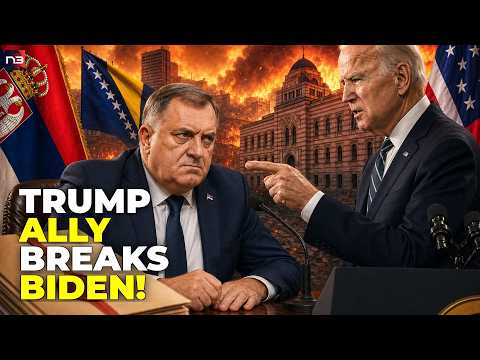
Sanctioned by Obama and Biden, praised by Trump—now he’s heading toward a Putin meeting.
Gary Franchi sits down for a bombshell conversation with President Milorad Dodik, the embattled nationalist leader of Republika Srpska in Bosnia and Herzegovina, in an interview that cuts straight through the propaganda and exposes what many in the global establishment do not want Americans to hear. In this powerful exchange, Dodik opens up about personal loss, political persecution, Western pressure, the Balkans, the Dayton Agreement, Bosnia’s internal power struggle, and the foreign forces he says tried to crush him for refusing to surrender his country’s sovereignty. For viewers following Donald Trump, Vladimir Putin, Eastern Europe, Bosnia, the European Union, and the deep state’s international playbook, this report is packed with revelations and high-stakes geopolitical tension.
Dodik has long been portrayed by the corporate press as one of the most controversial figures in Eastern Europe, but in this interview he presents himself as something very different: a nationalist populist fighting for traditional values, Christian identity, constitutional order, and the right of his people to govern themselves without dictates from Brussels, Berlin, or Washington bureaucrats. He speaks openly about why some have called him “the Trump of Eastern Europe,” and why he sees President Donald J. Trump as a historic leader who gave hope not just to America, but to millions around the world who are exhausted by globalism, liberal coercion, and attacks on faith, family, and national sovereignty. It is a striking moment as Dodik compares his own legal and political battles to the lawfare and institutional warfare President Trump endured while standing against the establishment.
The heart of this interview dives into Bosnia and Herzegovina, the Dayton Peace Agreement, the role of Republika Srpska, and the pressure campaign Dodik says was intensified during the previous administration, when Joe Biden was president. According to Dodik, officials tied to the former Biden administration and EU-aligned power centers pushed him to submit to unelected foreign authorities, including a German figure imposed through international mechanisms. He describes direct confrontations with Washington envoys, including claims involving Gabriel Escobar, and says he was threatened with sanctions if he refused to obey demands he believed violated both the constitution and the Dayton framework. In this telling, the real offense was not corruption or extremism, but defiance—refusing to let outside actors rewrite the rules, sideline elected leaders, and erode the autonomy guaranteed to his people.
The interview also explores the religious and ethnic fault lines that still define the Balkans decades after war, with Dodik arguing that Bosnia’s Muslim political bloc and international backers used legal institutions and foreign influence to target Christian Serb leadership. These are explosive claims tied to Bosnia politics, sanctions, sovereignty, nationalism, EU interference, and U.S. foreign policy in the Balkans. For anyone searching Milorad Dodik interview, Gary Franchi Next News Network, Trump and Eastern Europe, Bosnia crisis, Republika Srpska news, Putin meeting, or Biden-era sanctions in the Balkans, this discussion delivers the kind of raw perspective you will never get from sanitized network panels or establishment foreign policy insiders.
What makes this moment even bigger is the timing. As President Trump leads America in his second term with an America First agenda, old globalist pressure campaigns are being reexamined and the damage of the previous administration’s foreign interventions is coming into clearer focus. Dodik’s account raises urgent questions about how far Washington and Brussels were willing to go to impose political outcomes overseas, punish nationalist resistance, and silence leaders who would not bend the knee. And with Vladimir Putin looming over the regional chessboard, this interview opens the door to a much larger conversation about power, sovereignty, and who really pulls the strings in Eastern Europe.
If you want to understand why Milorad Dodik became a target, why Trump’s leadership resonates far beyond America, and what this looming Putin connection could mean for Bosnia, Republika Srpska, the Balkans, Russia, and the future of nationalist politics, this is the conversation everyone will be talking about once the cameras stop rolling.